Acroptilon repens - Russian Knapweed
Family: Asteraceae (Aster family) [E-flora]
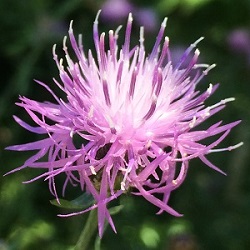
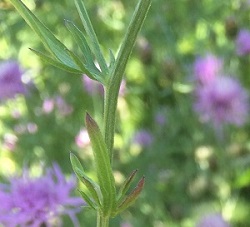
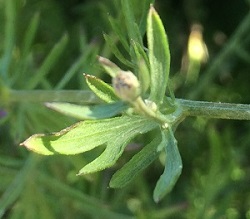

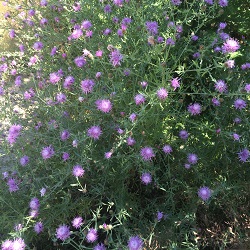
- General: "Perennial herb from a rhizome; stems erect, openly branched, densely woolly-hairy, 0.2-1.0 m tall." [IFBC-E-flora]
- Leaves: "Basal leaves oblanceolate, irregularly pinnately-lobed to entire, 3-10 cm long, 1.0-2.5 cm wide; lower stem leaves smaller, pinnately-lobed; upper stem leaves linear to narrowly lanceolate, entire or saw-toothed." [IFBC-E-flora]
- Flowers: "Heads with ray and disk flowers; involucres 9-15 mm tall; involucral bracts in several unequal series, entire, more or less soft-hairy with widely papery tips; ray flowers white to blue, 12-16 mm long; receptacles bristly." [IFBC-E-flora]
- Fruits: "Achenes egg-shaped, 3-4 mm long, slightly compressed, glabrous; pappus of many bristles barbed below, feathery above, more or less deciduous." [IFBC-E-flora]
- Habitat / Range: "Dry roadsides and disturbed areas in the steppe and montane zones; frequent in S BC east of the Coast-Cascade Mountains; introduced from Eurasia." [IFBC-E-flora]
Status: Exotic [E-flora]
- Synonyms and Alternate Names
- Centaurea repens [E-flora]
- Centaurea picris Pallas ex Willd. [E-flora]
- Rhaponticum repens 2/3 confidence accepted name [ThePlantList]
Hazards
"Severe poisoning in farm animals occurs when animals are fed hay containing small amounts of the herb, but toxicity has only been observed when plants are in flower; plants mowed before flowering do not seem to be poisonous (Ogolevitz 1951 ) . The plant causes a nervous system disease and neural cell necrosis when consumed by horses." [Eisenman MPCA]
Medicinal Use
"A water infusion of the herb is used to treat malaria, epilepsy, and other diseases. The root of the herb is used as an emetic (Khalmatov 1964 ) . In the folk medicine of Central Asia, Azerbaijan, and Crimea, a water infusion of the plant is used to treat malaria, and in Azerbaijan for treatment of epilepsy. Because this plant is poisonous, internal use of this species must be done with caution (Makhlayuk 1992 )" [Eisenman MPCA]
Phytochemicals
- Acroptilin [Connolly DT]
- Acroptin [Connolly DT]
- Acrorepiolide [Connolly DT]
- 4,15-Epoxy-3,9-dihydroxy-lO(14),11(13)-gualadlen-12,6-ohde;(Iß,3ß,4ß,5rx,6rx,9rx)-form, 9-(3-Chloro-2-hydroxy-2-methylpropanoyl) [Connolly DT]
- Repin [Connolly DT]
- 2,3,8-Trihydroxydehydrocostunolide; 8-(2-Methylpropenoyl) [Connolly DT]
"The plant contains traces of saponins, tannins and bitter substances, 4 % glycoalkaloids, 0.06 % essential oils and sesquiterpene lactones (Ogolevitz 1951 ; Stevens et al. 1990 ) . The main constituent of volatile oil isolated from the aboveground parts was caryophyllene oxide (36.6 %; Norouzi-Arasi et al. 2006 ) ." [Eisenman MPCA]
"Volatile oil isolated from the aboveground parts strongly inhibited the growth of the bacteria Staphylococcus saprophyticus and Staphylococcus epidermidis (Norouzi-Arasi et al. 2006 ) " [Eisenman MPCA]
"Polyacetylenes. This group of compounds is wide- spread in the Compositae family of plants, many of which are important weeds alleged to be allelopathic. Towers and Wat (54) reviewed the biological activity of these compounds and found them to be toxic to a variety of organisms. They suggested that some of the biological activities associated with Compositae, that had been attributed to sequiterpene lactones, might be effects of polyacetylenes." (Putname,1988)
"Stevens (48) isolated five pure polyacetylenes from Russian knapweed (Centaurea repens L. #CENRE), one of thich (Figure 10) proved strongly phytotoxic in a series of bioassays. Examination of soil around the roots of this plant throughout the growing season indicated that the compound was present at around 4 to 5 ppm in the soil. All of the polyacetylenes he isolated were C13 derivatives, each containing one thienyl group." (Putname,1988)
Cultivation & Propagation
"Subsequently, the native nematode Paranguina picridis, which produces galls on and causes stunting of Russian knapweed, Acroptilon repens, "in southern USSR, was also investigated as an in undative agent. When aqueous suspensions of the nematode were sprayed on fields infested by the weed, 50% of the plants were either destroyed or seriously damaged (lvanova 1966)." [Holzner BEW]
"Phytotoxic chemicals have recently been identified in the root exudates of C. diffusa (Vivanco et al. 2004), and in root exudates of the closely related knapweeds C. maculosa (Bais et al. 2002), and Acroptilon repens (formerly Centaurea repens) (Stermitz et al. 2003), strengthening the hypothesis put forth by Callaway and Aschehoug (2000) that chemical-based interactions may play a role in invasion ecology." [Zeng ASA]
Introduction
"Alfalfa seed (Medicago sativa) was imported into both eastern and western Canada from Russian Turkestan from about 1900 to 1922. Samples in Ontario in 1910 and 1914, and in Manitoba in 1920 were found to contain seeds of Centaurea repens. Years later, infestations of this weed in both provinces, as well as in Saskatchewan, Alberta and British Columbia, could be traced to its contamination of imported Turkestan alfalfa seed (Groh 1940; Mulligan and Findlay 1974)." [Holzner BEW]
Acroptilon Sp.
"Acriptilon is a monotypic genus native to eastern Europe and adjacent areas in Asia. Zheng et al. (1990a) reported apigenin 5-0-glucoside from A. repens (cited as Centaurea repens; generic referral from Dostal, 1976)." [Bohm FSF]
References
- [E-flora] Acroptilon repens, http://linnet.geog.ubc.ca/Atlas/Atlas.aspx?sciname=Acroptilon%20repens, In Klinkenberg, Brian. (Editor) 2017. E-Flora BC: Electronic Atlas of the Plants of British Columbia [eflora.bc.ca]. Lab for Advanced Spatial Analysis, Department of Geography, University of British Columbia, Vancouver. [Accessed: 08/06/2018 11:27:11 AM ]
- (Putname,1988) Putnam, Alan R. "Allelochemicals from plants as herbicides." Weed technology 2.4 (1988): 510-518.
- [ThePlantList] http://www.theplantlist.org/tpl1.1/record/gcc-86951. Accessed June 8, 2018. Information Taken from The Global Compositae Checklist
Data Analytics
Source Material Depth
This graph represents the unique prevalence of "Acroptilon, Centaurea repens, and Russian knapweed" within the Eflora local research library. Penetration indicates the percentage of total documents containing at least one of the search terms.