Leaves(?) Poultice
- Family: Aster - Asteraceae Family [E-flora]
- Other Names: American trailplant [E-flora]
Leaves(?) Poultice
 alt="Adenocaulon bicolor RF">
General:
Perennial herb from fibrous roots; stems slender, erect, 0.3-1.0 m tall, solitary, branched above, white-woolly on lower part, with stalked glands on upper part.
[IFBC-E-flora] "Trail plant is a slender, single-stemmed perennial herb up
to about three feet tall. The leaves are large, arrow-shaped, and arise from near
the base of the plant." [Vizgirdas WPSN]
Leaves:
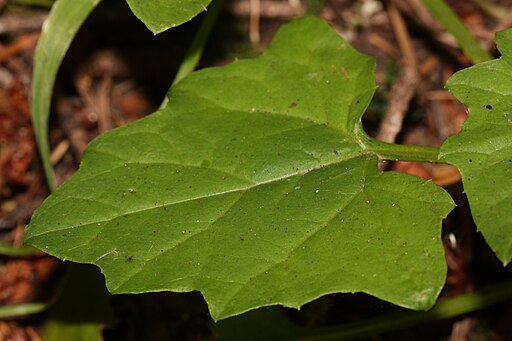
Mostly basal, large and thin, 10-30 cm long, 3-15 cm wide, long-stalked, broadly triangular to heart-shaped, green and essentially glabrous above, white-woolly below; margins smooth to coarsely toothed; stem leaves similar to basal, few, alternate.
[IFBC-E-flora]
Flowers:
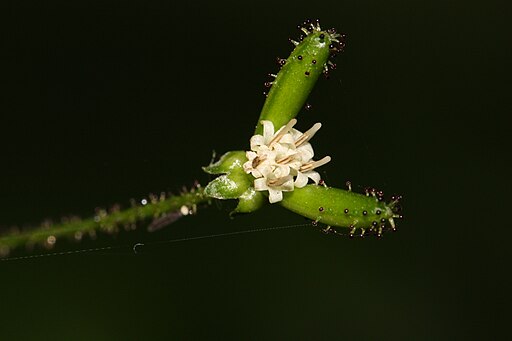
Heads discoid, small, several to numerous, in a branched, nearly naked, glandular inflorescence; rays lacking; disk flowers whitish, tubular, only the outer 3-7 fertile; involucres 2-3.5 mm tall, the bracts green, glabrous, equal in size, pointing down when mature and eventually deciduous. [IFBC-E-flora]
Fruits:
Club-shaped achenes, 5-8 mm long, with stalked glands on upper portion; pappus lacking.
[IFBC-E-flora]
Habitat / Range
"Moist to mesic forests in the lowland and montane zones; common in S BC; E to AB, S to ID, MT and N CA, disjunct in N MI."
[IFBC-E-flora]
Status: Native.[E-flora]
Ecological Indicator Information
"A shade-tolerant/intolerant, sub montane to montane, North American forb distributed in the Pacific (most frequently). Cordilleran, and Central regions. Occurs in cool temperate and cool mesothermal climates on moderately dry to fresh, nitrogen-rich soils; its occurrence decreases with increasing latitude and elevation. Sporadic in coniferous forests, scattered in broad-leaved forests on water-shedding sites. Often associated with Polystichum munitum and Tiarella trifoliata. A nitrophytic species characteristic of Moder and Mull humus forms." [IPBC-E-flora]
"Habit: Perennial herb. Stem: slender; base +- leafy.
Leaf: basal and cauline, alternate, reduced distally on stem; proximal leaves long-petioled; blades wide, thin.
Inflorescence: heads small, disciform, in open panicle-like clusters; involucre inconspicuous; phyllaries in 1--2 series, +- equal, reflexed in fruit, deciduous; receptacle convex, epaleate. Pistillate
Flower: few in 1 series; corolla deeply 4--5-lobed, white, early-deciduous.
Disk Flower: few, staminate, +- persistent; corolla cylindric, white; anther bases sagittate, tips narrowly triangular; style undivided.
Fruit: club-shaped to obovoid, weakly veined, prominently stalked-glandular; pappus 0.
Species In Genus: 6 species: western (central) North America, Central America, southern South America, eastern Asia.
Etymology: (Greek: gland stem)" [Jepson]
"This genus consists of five (Bittmann, 1990a, b; Bremer, 1994) species variously distributed in western North America, Chile, and eastern
Asia (Mabberley, 1987; Bittmann, 1990a, b). Its distribution is quite broad
for a genus of such small size, and its morphology makes tribal (and subtribal)
placement uncertain (Hansen, 1991). Even the possession of cortical vascular bundles (Karrfalt, 1975) is unusual (although not unique) within the
family. Recent macromolecular sequence investigations with the ndhF gene
(Kim and Jansen, 1995b), however, reveal Adenocaulon to belong in
Mutisieae near Mutisia (with some uncertainty; see Fig. 2-7). The only flavonoid chemistry of which we are aware is our finding (Bohm, unpubl.) of
kaempferol and quercetin 3-0-mono- and 3-0-diglycosides in A. bicolor." [Bohm FSF] The genus Adenocaulon is distributed in "W NA, Mexico, Hawaii, Guatemala, Chile, Arg, Himalayas, E Asia" [Werger PGC]
"Where there are many leaves in one spiral, long petioles in older leaves or narrow leaf bases in certain species can minimize leaf overlap (Leigh 1998). In the redwood forest understory plant Adenocaulon bicolor, which exhibits a spiral phyllotaxis with a mean diver- gence angle of 1378 (phyllotactic fraction of 8=21), leaf overlap was reduced by particular combinations of leaf size and petiole length at successive nodes (both increasing initially and then decreasing). The petiole length observed in this plant corresponded to the optimal petiole length obtained in simulations of the dependence of light absorption efficiency on petiole length (Pearcy and Yang 1998)." [Pugnaire FPE]
"...there are particular cases in which the several functions of a given structure do not appear to be a constraint in interpreting its functional optimization, such as the analysis of petiole length versus light capture in the understory herb Adenocaulon bicolor (Pearcy and Yang 1998)." [Pugnaire FPE]
"Pfitsch and Pearcy (1992) found no correlation between estimates of sunfleck light availability and growth of the redwood forest understory herb, Adenocaulon bicolor. Variation in daily carbon gain and in the proportion of the annual carbon gain contributed by photosynthetic utilization of sunflecks was, however, highly correlated with the variation in sunfleck availability (Pearcy and Pfitsch 1991). Moreover, removal of sunflecks with shadow bands designed to block sunfleck transmission along the solar track but pass most of the diffuse PFD, significantly reduced growth and reproduction (Pfitsch and Pearcy 1992). Thus, there is no doubt that sunfleck utilization was important to these plants but other limitations may have prevented translation of the spatial variation in sunfleck PFD into spatial variation in growth. There is evidence for only minor losses of carbon gain due to photoinhibition in sunflecks (Pearcy 1994) so other factors such as drought stress and increased competition in the brighter microsites need to be considered." [Pugnaire FPE]
"Tribe Nassauvieae
Nassauvieae consists of those genera currently seen as comprising sub tribe
Nassauviinae of Mutisieae (Bremer, 1994). We have flavonoid data for seven
genera, eight counting the anomalous Adenocaulon, recognized as constituting this assemblage. No single flavonoid
factor unites the group, although
it is difficult to assess the significance of the data since much of the information came via volunteer compounds in
studies of sesquiterpenes. As a
result, we have very little information concerning vacuolar constituents.
Adenocaulon (A. bicolor) afforded flavonol glycosides (Bohm, unpub1.),
while the other genera yielded a diverse array of flavones, flavonols, and
flavanones. Some had no B-ring substituents, and extra oxygenation at C-6
was common. A study of polar flavonoid derivatives is needed to remedy
this all too common situation." [Bohm FSF]
Selenium Accumulator: "Among the 14 plant species in
Enshi, Adenocaulon himalaicum has the highest contents of Se from 299 to 2,278
(mean 760) mg/kg DW in the leaf, from 268 to 1,612 (mean 580) mg/kg DW in the
stem, from 227 to 8,391 (mean 1,744) mg/kg DW in the root, and therefore was
identified as a secondary Se-accumulating plant." (Yuan et al., 2012)
"Our results showed that Adenocaulon himalaicum had exceptional high concentrations of Se with 563.60 mg/kg DW in the root and 1,317.46 mg/kg DW in
the leaf, followed by Medicago sativa that accumulated Se concentrations of
150.96, 154.40, and 168.14 mg/kg DW in root, stem, and leaf, respectively." (Yuan et al., 2012)
"Overall, Adenocaulon himalaicum displayed the exceptional ability to accu-
mulate Se in its root, stem, and leaf tissues." (Yuan et al., 2012)
"The total Se concentrations were 760 ± 692 mg/kg DW in the leaf, 580 ± 468 mg/kg DW in the
stem, and 1744 ± 2978 mg/kg DW in the root. Selenium speciation analysis
indicated that SeCys2, SeMeCys, and SeMet accounted for 70–98, 7–19, and
3–11 %, respectively, of the total Se accumulated in Adenocaulon himalaicum
leaves.... A similar pattern occurred in the stem and the root tissues. The
proportion of SeCys2 in Adenocaulon himalaicum increases with increasing the
accumulation of total Se in the plant tissues." (Yuan et al., 2012)
Aphid Host Plant
This graph represents the unique prevalence of "Adenocaulon" within the Eflora local research library.


