Aegopodium podagraria - Goutweed
Google Gemini - Created with AI prompt (This page needs extra scrutiny)
- Family: Apiaceae (Carrot) (CTW Flora)
- Other Names: Ground Elder, Bishop's Weed, Herb Gerard, Snow-in-the-mountain. (CTW Flora)

(Wikimedia)1
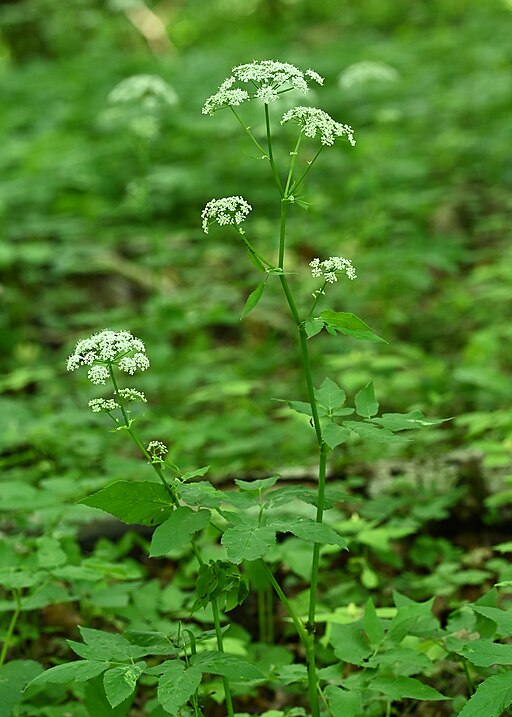
(Wikimedia)2
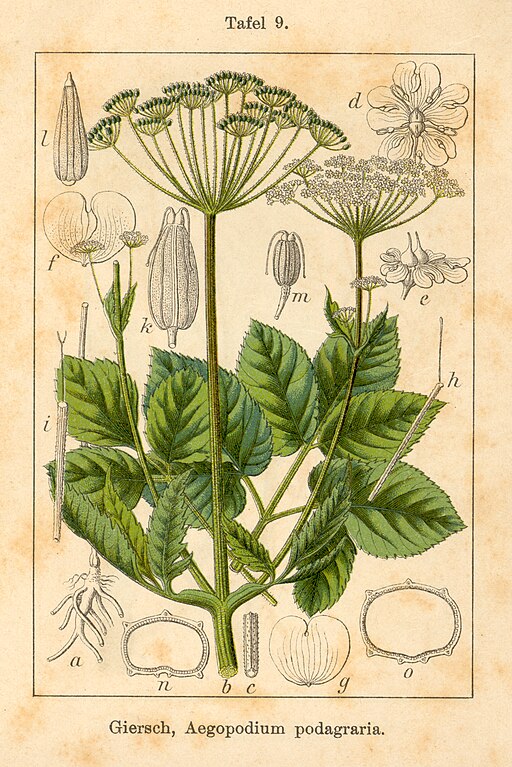
(Wikimedia)3
Synonyms
- Apium podagraria (L.) Caruel (GBIF)
- Carum podagraria (L.) Roth (GBIF)
General: Herbaceous perennial. (Invasive.org)
Lifecycle: Perennial, spreading aggressively by rhizomes. (CTW Flora) "Perennial herb from a long-creeping rhizome, often in bundles; plants creeping, patch-forming; stems hollow, grooved, glabrous, 0.3-1.0 m tall." [IFBC-E-flora]
Flowers: Numerous small, white, 5-petaled flowers arranged in flat-topped compound umbels, 6-12 cm across. Blooms late spring to mid-summer. (IlliWild) "Inflorescence terminal in compound umbels; petals white or sometimes pink, usually lacking bracts." [IFBC-E-flora]
Fruits: Small (3-4 mm), ovoid-oblong, ridged, and somewhat flattened. (IlliWild) "Egg-shaped, 3-4 mm long, ribs inconspicuous." [IFBC-E-flora]
Leaves: Alternate, compound. Lower leaves are typically triternate (divided into three groups of three leaflets). Leaflets are 3-8 cm long, ovate, and toothed. (EDDMapS) "Basal leaves 2 times pinnately-cut, leaf segments stalked, egg-shaped, the tips long-pointed, stem leaves deeply indented with leaflets once to several times compound, 10-20 cm long, the segments 4-8 cm long, sessile or shortly stalked, reduced upwards." [IFBC-E-flora]
Habitat: Thrives in moist, shaded areas like forest edges, ravines, and disturbed ground.
Highly tolerant of various conditions. (Invasive.org) "Mesic to dry roadsides and waste places in the lowland zone" [IFBC-E-flora]
Range: Native to Europe and temperate Asia. Introduced to North America, Australia,
and New Zealand as an ornamental groundcover and is now widely naturalized and invasive. (GISD) "rare in SW BC, known only from the lower Fraser Valley;
introduced from Eurasia." [IFBC-E-flora]
Status: Exotic [IFBC-E-flora] Introduced, Noxious, Invasive in many regions. (Invasive.org) (GISD) "Notes:
This is potentially a very persistent weed, especially in calcareous habitats." [IFBC-E-flora]
Ecological Indicator: A highly competitive, shade-tolerant plant that forms dense, monotypic stands, displacing native herbaceous species and preventing the establishment of tree seedlings. Its presence indicates a disturbed or invaded ecosystem. (Invasive.org)
Possible Lookalikes: Extreme caution is advised. As a member of the Apiaceae family, it can be confused with deadly poisonous species like Poison Hemlock (Conium maculatum) and Water Hemlock (Cicuta maculata). It also resembles the native Honewort (Cryptotaenia canadensis), which has leaves divided into only three leaflets, unlike Goutweed's typical nine. (FVISS) (bplant)
"Additional Notes This species spreads easily from root fragments and can spread into new areas as a result of the dumping of garden debris. It forms dense patches, displaces native species, and greatly reduces species diversity in the ground layer." [IFBC-E-flora]
"Aegopodium podagraria is a non-native, invasive herb that has escaped cultivation in the region. It grows in forests, at forest edges, and along borders. Though this plant is most frequent near human habitation, it can sometimes be found relatively far from homes in minimally disturbed forests. It has twice-pinnately compound leaves with toothed leafules, and flowers with five small, white petals. The inflorescence is an umbel, which is a flat- or round-topped array of flowers in which all the branches originate from a common point. Aegopodium, like many members of the Apiaceae (celery family), has a compound umbel (i.e., the inflorescence branches branch again and each supports a small groups of flowers called an umbellet). The umbellets lack bractlets (or have 1 or 2 small ones) at the base (some genera in the celery family have a regular series of bractlets around the base of the umbellet). This species is perhaps easiest to learn in fruit. The two styles are bent backward and extend downward to near the mid-length of the seed- like fruit that ultimately splits into two halves. The foliage is either entirely green or often white- striped or white-blotched in horticultural forms (referred to as maculate). The plant usually flowers in July and early August." [Haines AP]
Hazards
- EXTREME DANGER of confusion with deadly poisonous members of the Carrot family (Apiaceae). Positive identification is essential before any use. (FVISS)
- Considered one of the most aggressive and difficult-to-eradicate invasive plants in gardens and natural areas. Spreads relentlessly via underground rhizomes. (BBG)
- Older leaves are reported to have a pungent taste and a mild laxative effect if consumed. (Mabey FFF)
- "No health hazards or side effects are known in conjunction with the proper administration of designated therapeutic dosages." [PDR] "Contraindications, Interactions, and Side Effects (Goutweed) — Not covered (AHP; PH2)." [HMH Duke]
Food Uses
"The analysis of botanical, ethnographic, linguistic and historical information led Moszyński to the conclusion that pre-Slavs had not made use of wild starchy plants because they had cultivated cereals, some of which they domesticated themselves. But apart from cereals, they cultivated very few vegetables, hence they procured leafy vegetables in the wild (e.g. Rumex spp., Aegopodium podagraria L., and Heracleum sphondylium L.). This custom has survived until modern times (Moszyński1962: 138–140)." [Svanberg EE]
"Ground elder Aegopodium podagraria Apiaceae A widespread perennial weed in Europe, northern Asia, and the United States that can be easily cultivated for its edible leaves. It is thought that the Romans introduced it to Britain as a vegetable eaten rather like spinach. It was widely cultivated in the Middle Ages, especially in the herb gardens of castles and monasteries. It can still be found growing in their ruins." [Prance TCHP]
"Aegopodium podagraria Linn. Umbelliferae. ASHWEED. BISHOP'S- WEED. GOUTWEED. GROUND ASH. HERB GERARD. Europe and adjoining Asia. Lightfoot says the young leaves are eaten in the spring in Sweden and Switzerland as greens. It is mentioned by Gerarde. In France it is an inmate of the flower garden, especially a variety with variegated leaves." [Sturtevant EPW]
"In the Ukraine, the name “green borsh” designates any soup made of green vegetables, e.g., Rumex acetosa, Chenopodium album and Urtica dioica, which indicates that in the past mixed soups of many species of wild vegetables could have been more common everywhere....In some parts of Ukraine (e.g., in the Uman area) the use of Aegopodium podagraria for green borsh also still occurs (Kuzemko, 2008)." [ETWP]
"In southern Europe, many bitter-tasting Asteraceae species have been eaten in rural communities (e.g., Leontodon, Cichorium, Hypochaeris, Sonchus), whereas these same species were usually passed by as edible plants further north in Europe, where there was usually a sufficient supply of less bitter green shoots and leaves of plants (e.g., Urtica, Chenopodium, Aegopodium) to be found in the grasslands and fields. This difference in use of bitter tasting plants may represent a cultural choice, but the primary underlying reason for variation may be the availability of green shoots in a particular landscape." [ETWP]
"A plant that disappeared from the Polish menu even earlier is a relative of hogweed—ground elder, Aegopodium podagraria. Ground elder was sold in the market of Cracow in medieval times but later came into disuse (Maurizio, 1927). Its consumption in the past was documented in only a few villages (Luczaj, 2008a; Piroznikow, 2008). However its consumption in Belarus was widespread, at least until the end of the nineteenth century. The relatively small cultural importance of Aegopodium must be Poles’ cultural choice as this wild vegetable is widespread and abundant and was commonly used in some other European countries (Hedrick, 1919)." [ETWP]
"Many species consumed during famine or food scarcity in the 19th century and during World War I in Germany and Austria [1], and common in Poland, e.g. Aegopodium podagraria and Alliaria petiolata, also do not appear in Polish culinary ethnographic literature either. The use of some of these species might have become obsolete before ethnographic studies began, e.g. Aegopodium podagraria leaves used for potherb in medieval times [66]. Looking at the use of potherb plants, four categories of plants can be distinguished. Firstly, plants which were probably used as potherb only before written records (e.g. Aegopodium podagraria, Angelica sylvestris, Alliaria petiolata)." (Luczaj, 2007)
"The leaves are slightly aromatic and excellent eaten raw or cooked. Their flavor is reminiscent of Pimpinella anisum (anise). The youngest leaves (bright green and somewhat translucent) are best used as salad ingredients. These generally begin to appear in late April, and new leaves will be produced throughout much of May. After the leaves are older, they become darker green and opaque. They are still good as a potherb. Though the leaves of Aegopodium podagraria can be eaten through much of the growing season, they are best in the spring while they are still tender. They can also be infused to make a pleasant tea." [Haines AP]
- Young Leaves: The tender young leaves can be used as a spring vegetable, similar to spinach. They are best harvested from early spring until just before the plant flowers (April-May). They can be eaten raw in salads (in moderation), cooked in soups, or used as a potherb. (Mabey FFF) (PMC)
- "The young leaves are perfectly edible if boiled like spinach (see Jordan)." [DPL Watts]
Other Uses
- Ornamental: The variegated form ('Variegatum') was widely introduced as a low-maintenance, shade-tolerant groundcover. However, due to its extreme invasiveness, planting it is now strongly discouraged. The variegated form often reverts to the more aggressive, solid green type. (BBG)
Medicinal Uses
"Primarily, though, and as the common name shows, this is a medicinal herb, and a gout cure in particular, or at least a treatment for gout, over the centuries. It was even cultivated once, specifically for that treatment (Beith). The specific name podagraria means good for gout, from podagra, gout in the feet. Gerard knew the cure, of course, for it was known long before his time: Herb Gerard with his roots stamped, and laid upon members that are troubled or vexed with the gout, swageth the paine …”. Nowadays a tea might be prescribed, but Culpeper even believed that “the very bearing of it about one easeth the Pains of the Gout, and defends him that bears it from the Disease”. The name Gerard used in the quote above, Herb Gerard, has nothing to do with the 16th century herbalist, but with a Saint Gerard, probably not one of the two or three saints of that name recognized as such, but perhaps merely apocryphal, and the patron of gout sufferers, once invoked to cure the disease. The point is that the Dutch for the ailment and the plant is geraert, and the German Giersch for the plant and Gicht for gout. Bishop’s Weed (Britten & Holland), or Bishop’s Elder, from the Isle of Wight (Grigson) are two of the many names for the plant. Were bishops particularly prone to gout? Probably so, but the real reason for the names is likely to be the fact that this plant is so often found near ecclesiastical ruins; it was said that monks introduced it (Grieve)." [DPL Watts]
"Herbalists still prescribe it as a diuretic and sedative, hence as a painkiller (Le Strange). Drinking the infusion can help aching joints, and sciatica can be treated with it; the practice in the Highlands (Beith) and in Ireland (Moloney) was to make a poultice of the crushed herb. Eczema can be cured by drinking daily a half pint of the tea (A W Hatfield), and in East Anglia, the juice was squeezed on warts (V G Hatfield)." [DPL Watts]
"Aegopodium podagraria has been used in folk medicine to assist with several ailments. Infusions of the leaves (and other parts of the plant) have long been used internally as a tea to abate the symptoms of painful joints due to arthritis, rheumatism, and gout. Recent research has shown that Aegopodium podagraria contains the lipid falcarindiol, a phytochemical that inhibits cyclooxygenase-1 (COX-1) formation. COX-1 is a compound responsible for inflammation and pain. The highest concentrations of falcarindiol were found in the flowers (though it is present in other parts of the plant). Research also demonstrated that falcarindiol and related polyacetylenes have antimicrobial function, with activity against some bacteria and fungi. This supports the folk use as a vulnerary—poulticed leaves can be placed on minor skin ailments (e.g., cuts, burns, insect stings) to allay infection. Infusions of Aegopodium podagraria are also reported to have diuretic and sedative properties." [Haines AP]
"Tab. praised the common European plant Aegopodium podagraria L. (Ground elder) in his eyes a “despised and unlovely weed” for its remarkable medicinal value for gout and joint pains. Tab. recommends cooking Aegopodium podagraria in wine, which is to be drunk twice a day in both morning and evening. This should heal gout of the feet and as hip pains. Ground elder has been traditionally used in Europe in folk and monastic medicine for gout and similar ailments known as podagra. This led to it being named Aegopodium podagraria (Duke et al., 2002)." (Adams et al., 2009)
"Production: Goutweed is the aerial part of Aegopodium podagraria." [PDR]
"Unproven Uses: The herb is used internally as an infusion for gout and rheumatic diseases. It is used externally in macerations for poultices and baths for hemorrhoids, gout and rheumatic diseases, as well as for kidney and bladder disorders and intestinal disorders." [PDR]
- Traditional Use: Historically, as its name suggests, Goutweed was a primary folk remedy for treating gout and arthritis. Both leaves and roots were boiled and used in hot wraps applied externally to affected joints. (Mabey FFF) (PMC)
- Internal Use: Ingested as a tea, it was believed to have diuretic, anti-inflammatory, and mild sedative properties, used for rheumatism and disorders of the kidney and bladder. (RxList) (PMC)
- Modern Status: Its use as a medicinal herb has largely declined. There is insufficient scientific evidence to rate its effectiveness for any medical condition. (RxList)
"Mode of Administration: Internally as a tea; externally, the fresh herb is squeezed for poultices." [PDR]
"Daily Dosage: There is no exact dosage. A daily recommended dose consists of 1 to 2 dessertspoonfuls (30ml) of the juice of the fresh plant." [PDR] "Dosages (Goutweed) — 30–60 ml fresh plant juice (PH2)." [HMH Duke]
GOUTWEED (Aegopodium podagraria L.)"Activities (Goutweed) — Antitumor (f; DAW); Diuretic (f; DAW); Resolvent (f; DAW); Sedative (f; DAW); Stimulant (f; DAW); Vulnerary (f; DAW)." [HMH Duke]
"Indications (Goutweed) — Arthrosis (f; GMH); Cancer (f; DAW; JLH); Cystosis (f; PH2); Enterosis (f; PH2); Gout (f; PH2); Hemorrhoid (f; PH2); Inflammation (f; GMH); Insomnia (f; DAW); Nephrosis (f; PH2); Nervousness (f; DAW); Pain (f; GMH); Rheumatism (f; PH2); Sciatica (f; DAW); Tumor (f; DAW); Water Retention (f; DAW)." [HMH Duke]
Phytochemistry & Allelopathy
Goutweed contains a variety of compounds, including flavonoids (quercetin, kaempferol), coumarins, and polyacetylenes such as falcarindiol, which has shown antifungal and anti-inflammatory activity in studies. The essential oil contains terpenes like α-pinene and β-caryophyllene. (PMC) (ACSPubs)
"Volatile oil
Polyynes: only in freshly-harvested leaves
Flavonol glycosides: including hyperoside, isoquercitrin
Caffeic acid derivatives: including chlorogenic acid
Ascorbic acid" [PDR]
"Aegopodium podagraria
Family: Apiaceae
Essential oil, %: 0.001–0.05
Aerial Part
Essential oil, %: 0.04
Components: Limonene, b-phellandrene
b-Sitosterol
Fruit
Essential oil, %: 0.04
Inflorescence
Essential oil, %: 0.14
Leaf
Essential oil, %: 0.04–0.07
Stem
Essential oil, %: 0.02–0.06" [LLCEOPS]
"underground rhizomes of the ground elder (Aegopodium podograria), a member of the Apiaceae family, have been found to contain lectins that comprise 3-5% of the soluble protein in these tissues (Cammue et al., 1985a; Broekaert et al., 1984; Peumans et al., 1985)." [Liener Lectins]
"Aegopodium podagraria contains the polyacetylene falcarindiol, which in an in vitro study by Prior et al. (2007) inhibited COX-1 with an IC50 of 0.3 M (IC50 indomethacin = 9 M). Falcarindiol is active against 12-LOX and 15-LOX. The plant contains some essential oil (Paramonov et al., 2000) and lectins (Peumans et al., 1985) but other than this little is known about the phytochemistry of this common Apiaceae." (Adams et al., 2009)
Allelopathy: The plant is known to have allelopathic properties, releasing chemicals that inhibit the germination and growth of nearby plants. This chemical inhibition is a key factor, along with its dense rhizome network, that allows it to form dominant monocultures and outcompete native flora. (ACSPubs)
Management and Control
Cultivation of Goutweed is not recommended due to its invasive nature. The focus should be on control and eradication.
- Mechanical Control: For small patches, persistent hand-pulling and digging can be effective, but every piece of the white, brittle rhizome must be removed, as fragments will resprout. This process can take several years. (ISC)
- Mowing: Repeatedly cutting the plants to the ground can weaken them over time by depleting the energy reserves in the rhizomes. (BBG)
- Tarping: Covering the infested area with heavy, opaque tarps or black plastic for at least one full growing season can smother the plants by blocking all sunlight. (ISC)
- Barriers: If containment is the only option, installing deep underground barriers (like metal or plastic sheeting) can help prevent its spread into new areas. (BBG)
Fungal Pathogens
"Plasmopara nivea is occasionally reported in Britain on umbelliferous crops such as carrot and parsnip, and it is also found on Aegopodium podagraria." [IntrotoFun3]
Propagation
Goutweed spreads almost exclusively through its extensive network of underground rhizomes. Any small piece of rhizome can generate a new plant. This makes mechanical tilling or careless digging counterproductive, as it can multiply the infestation. (Invasive.org)
"The rhizome of Aegopodium podagraria (goutweed), and probably of other species, is able, by adjusting the orientation of its growing region, to maintain itself at an almost constant depth beneath the surface of the soil. The physiological mechanism underlying this remarkable behavior is still not wholly known, but the ambient oxygen tension is probably an important factor." [GPOD]
While it does produce seeds, seedling establishment is less common and typically restricted to disturbed areas with ample light. The primary vector for its spread to new locations is through human activity, either by intentional planting or the improper disposal of garden waste containing rhizomes. (GISD)
Lore & History
Goutweed is believed to have been introduced to Great Britain by the Romans and spread throughout Northern Europe by monks who cultivated it as both a food and medicinal plant. Its names, such as Bishop's Weed and Goutweed, directly reference its historical use in treating gout, a condition that historically afflicted the wealthy, including bishops, who consumed rich diets. The common name "Jack-Jump-About" from the 16th century aptly describes its invasive, spreading nature. (ChangingLifestyle) (Mabey FFF)
Synonyms
- Aegopodium podagraria var. variegatum L.H. Bailey [IFBC-E-flora]
AEGOPODIUM GOUTWEED
Family: Apiaceae - Carrot
A genus of about seven species of perennial herbs native to Europe and western Asia. Stems are typically erect and grooved. Leaves are compound, often ternately divided. Flowers are small, white, and borne in compound umbels. The genus is infamous for its type species, A. podagraria, which is a notoriously aggressive invasive weed throughout the temperate world where it has been introduced. (Wiki)
Phytochemistry
"Aegopodium alpestre Ledeb.
Family: Apiaceae
Fruit
Mass of 1,000, g: 2.020
Essential oil, % abs. dry wt: 3.12" [LLCEOPS]
"Aegopodium tadshikorim Schischk.
Family: Apiaceae
Leaf
Carotene" [LLCEOPS]
References
- (ACSPubs) - Svenberg, Linus, et al. "Investigation of the Chemical Inhibition Effect of Ground Elder (Aegopodium podagraria) on Timothy (Phleum pratense)─ Introducing High School Students to Analytical Chemistry and Chemical Ecology." Journal of Chemical Education 100.3 (2023): 1227-1236.
- (Adams et al., 2009) Adams, Michael, et al. "Medicinal herbs for the treatment of rheumatic disorders—a survey of European herbals from the 16th and 17th century." Journal of ethnopharmacology 121.3 (2009): 343-359.
- (bplant) - Honewort vs Bishop's Goutweed: Identification, bplant.org.
- (BBG) - Weed of the Month: Goutweed, Brooklyn Botanic Garden.
- (ChangingLifestyle) - Weed of the Week Aegopodium podagraria L. Ground Elder, changinglifestyleblog.uk, 2015.
- (CTW Flora) - Clapham, A. R., Tutin, T. G., & Warburg, E. F. (1962). Flora of the British Isles. Cambridge University Press. (As cited in Wikipedia for general botanical information).
- E-flora - Aegopodium podagraria, E-flora BC, https://linnet.geog.ubc.ca/Atlas/Atlas.aspx?sciname=Aegopodium%20podagraria, Accessed Jan 26, 2026
- (EDDMapS) - Goutweed (Aegopodium podagraria L.), Early Detection & Distribution Mapping System.
- (FVISS) - Look-Alikes: Hogweed & Chervil, Fraser Valley Invasive Species Society.
- (GBIF) - Aegopodium podagraria L., Global Biodiversity Information Facility.
- (GISD) - Global Invasive Species Database (2010). Aegopodium podagraria (herb). (As cited in Wikipedia).
- (IlliWild) - Goutweed (Aegopodium podagraria), Illinois Wildflowers.
- (Invasive.org) - PCA Alien Plant Working Group - Goutweed, Center for Invasive Species and Ecosystem Health.
- (ISC) - Goutweed, Invasive Species Centre.
- (Luczaj, 2007) Łuczaj, Łukasz, and Wojciech M. Szymański. "Wild vascular plants gathered for consumption in the Polish countryside: a review." Journal of ethnobiology and ethnomedicine 3.1 (2007): 17.
- (Mabey FFF) - Mabey, Richard (1972). Food for Free. London: Collins. ISBN 0-00-211246-9. (As cited in Wikipedia for ethnobotanical uses).
- (PMC) - Goutweed (Aegopodium podagraria L.)—An Edible Weed with Health-Promoting Properties, PubMed Central, 2024.
- (RxList) - Goutweed: Health Benefits, Side Effects, Uses, Dose & Precautions, RxList.
- (Wiki) - Wikipedia contributors. "Aegopodium podagraria." Wikipedia, The Free Encyclopedia. Web. 10 Aug. 2025. <https://en.wikipedia.org/wiki/Aegopodium_podagraria>.
Image References
- Markus Weber, CC BY-SA 4.0
- Krzysztof Ziarnek, Kenraiz, CC BY-SA 4.0
- Johann Georg Sturm (Painter: Jacob Sturm), Public domain, via Wikimedia Commons
Journals of Interests
- Kemp, M. S. (1978). Falcarindiol: An antifungal polyacetylene from Aegopodium podagraria. Phytochemistry, 17, 1002.
- Prior, R. M., Lundgaard, N. H., Light, M. E., Stafford, G. I., van Staden, J., & Jager, A. K. (2007). The polyacetylene falcarindiol with COX-1 activity isolated from Aegopodium podagraria L. Journal of Ethnopharmacology, 113, 176–178.
- Paramonov, E.A., Khalilova, A.Z., Odinokov, V.N., Khalilov, L.M., 2000. Identifica- tion and biological activity of volatile organic compounds isolated from plants and insects. III. Chromatography-mass spectrometry of volatile compounds of Aegopodium podagraria. Chemistry of Natural Compounds 36, 584–586.
- Peumans, W.J., Nsimba-Lubaki, M., Peeters, B., Broeckaert, W.F., 1985. Isolation and partial characterization of a lectin from ground elder (Aegopodium podagraria) rhizomes. Planta 164, 75–82.
Data Analytics
Source Material Depth
This graph represents the unique prevalence of "Aegopodium" within the Eflora local research library. Penetration indicates the percentage of total documents containing at least one of the search terms.