Family: Poaceae [E-flora]
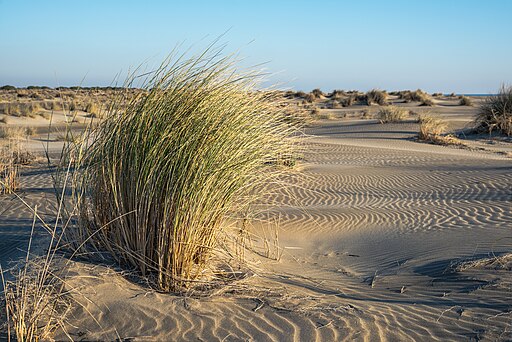
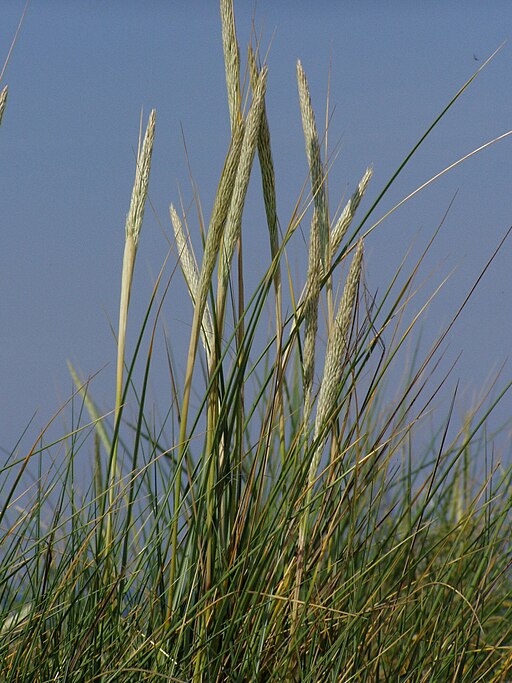
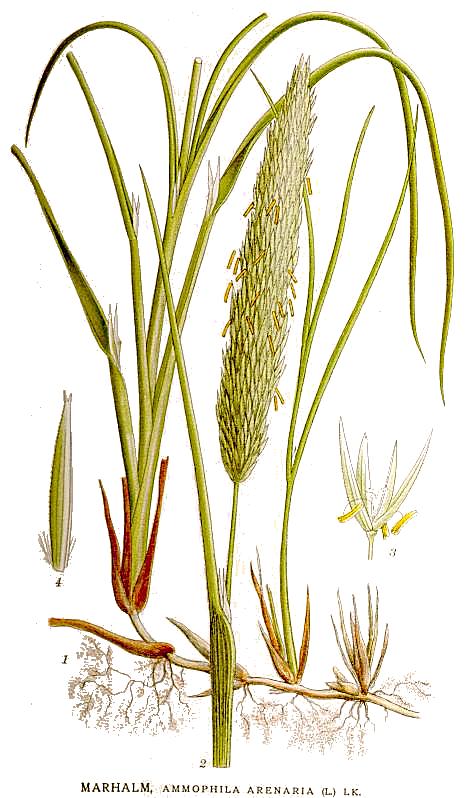
This species was introduced to the beaches of western North America in the mid-nineteenth century for sand dune stabilization, and can now be found from California to British Columbia. It is invasive in sand dune systems where it can produce dense homogeneous stands. It "has changed the topography of some California beach ecosystems, especially in sand dunes...and was a major cause of the destruction of native dune habitat in Oregon and Washington during the twentieth century" (Wikipedia 2009).[E-flora]
"The most important form of habitat loss to coastal
breeding individuals has been the encroachment of
European beachgrass (Ammophila arenaria). This
non-native plant was introduced to the West Coast around 1898 to stabilize dunes. Since then, it has
spread up and down the coast and now is found
from British Columbia to southern California (Ven-
tura County). In the late twentieth century, Euro-
pean beachgrass was a major dune plant occurring
at about 50% of California breeding sites and all of
those in Oregon and Washington. Stabilizing sand
dunes with European beachgrass has reduced the
amount of nonvegetated area above the tideline, de-
creased the width of the beach, and increased its
slope. These changes have reduced the amount of
potential nesting habitat for the species on many
beaches and may hamper brood movements. The
beachgrass community also provides habitat for
predators of the species which historically would
have been largely precluded by the lack of cover in
the dune community. In addition, the presence of
beachgrass may adversely affect food supplies. The
abundance and diversity of sand dune arthropods
are markedly depressed in areas dominated by Eu-
ropean beachgrass." [Beacham ESNA V.1]
Sand dunes and sandy beaches in the lowland zone; locally frequent on the Queen Charlotte Islands, Vancouver Island and the lower mainland (Crescent Beach); introduced from Europe.
[IFBC-E-flora] "Dunes, disturbed areas; native of Europe. Introduced in MD
and PA" [Weakley FSMAS]
"This is a robust and sclerophyllous perennial grass which functions as an evergreen geophyte or chamaephyte. It is confined to mobile sand dunes, mostly in coastal areas of Europe, Asia, and Africa (Huiskes 1979; Gehu 1985). It was introduced to the western coast of the USA in the late 1800s. It has since spread north to Canada and south to San Louis Obispo (Breckon and Barbour 1974). Environmentalists agree that the plant spreads aggressively in California and in many places has caused the disappearance of the native vegetation of the mobile dunes. It occupies mobile sand, but may also dominate stable coastal dunes in Europe ("grey dunes" of Chapman 1976). Old stable coastal dunes at Bodega Head and Point Reyes peninsula, California, for example, are dominated by A. arenaria." [Danin PDD]
"Growing in areas with relatively high amounts of rainfall, the continuous vertical reactive growth of orthogeocorms leads to the formation of high dunes. This is true in many coastal areas of Europe where the foredune looks like a vegetated wall separating the land from the sea. The tendency for the foredune to grow vertically and to arrest mobile sand in coastal California has been discussed by Barbour et al. (1993) in relation to its impact on decreasing habitat and species diversity. Our study of plant succession on coastal dunes in Bodega Head, California (Danin et al. 1995) shows sand accretion in A. arenaria nebkas to have been at a rate of 10 cm/year for the last 40 years." [Danin PDD]
"...planted dune grass species Ammophila arenaria, which is attacked by various root fungi and nematodes, and may temporarily escape by growing its roots towards pathogen-free blown-in sand (van der Putten et al. 1993)". [Dighton IIS]
"Ammophila arenaria (Linnaeus) Link European dune grass, European beach grass Native to coastal Europe and northern Africa. The species epithet means of the sand. This adaptable, aggressively run- ning species has been planted far beyond its natural range for erosion control in dunes and other sandy soils. Such plant- ings have displaced American dune grass populations on the West Coast of North America and pingao sedges (Desmoschoe- nus spiralis) that normally occupy the same habitat niche in New Zealand. Although also introduced to the eastern coast of North America, Ammophila arenaria has not proved as per- sistent there as the local native, A. breviligulata. Zone 5." [Darke EGLL]
"The use of grasses and sedges in the restoration and enhancement of regional landscapes extends far beyond the roadside, as evidenced by this dune stabilization proj- ect in Wellington, New Zealand. The bright orange foliage belongs to pingao, Desmos- choenus spiralis, a New Zealand native sedge that is a natural component of dune vegeta- tion. Many New Zealand dune systems were damaged by poor farming practices, and early twentieth-century attempts to stabilize them typically made use of the exotic mar- ram grass, Ammophila arenaria, which is na- tive to Europe and Africa. In addition to its beautiful color, Desmoschoenus is preferable because it creates smooth, stable fore dunes as opposed to the steep, blowout-prone dunes formed by Ammophila." [Darke EGLL]
"The separation between them seems to arise from the fact that cluster MoPi1 includes all releve´s containing Cytisus scoparius and Ammophila arenaria, two non-native species intro- duced to stop dune front advance that consequently appear more frequently in mobile and semi-stabilized sands." (peinado2011)
"In New Zealand, extensive use is made of perennial lupins (lupinus arboreus)in sand-dune reclamation. After the establishment of marrem grass (Ammophila arenaria) with, or without lupins, Pinus radiata seedlings are plant- ed, either with lupin seed or after line cutting through lupin scrub." (reid_phd_vol1)
"Among the native plants that can stabilize a low dune is dune grass (Leymus mollis subsp. mollis); a still more effective stabilizer is beach grass (Ammophila arenaria subsp. arenaria), brought to North America from Europe to reduce the extent to which loose sand moves in the direction of homes and highways." [Kozloff PWO]
"Few species that are confined to desert dunes and require accumulating sand (Sect. 5.1) have plagiotropic rhizodes. Panicum urvilleanum, however, has a well-developed rhizode system with orthogeocorm tillers. The most successful nondesert pioneers, Ammophila arenaria, and A. breviligulata, can also ex- pand by rhizodes and by orthogeocorms. Rhizodes may also serve as carbohy- drate reserves, as in A. breviligulata (Seliskar 1994)." [Danin PDD]
"All members of the ecomorphological group of species confined to areas of sand accretion have orthogeocorms. Orthogeocorms enable them to withstand sand accretion. The vertical cover of sand on the plant must be overcome by reactive vertical growth. Stipagrostis species and Swallenia alexandrae achieve such vertical growth by producing aerial tillers which turn into orthogeocorms and develop nodal roots when covered by sand. Panicum urvilleanum and Ammophila arenaria produce orthogeocormic tillers which carry leaves." [Danin PDD]
"... when examining the contribution of root-feeding nematodes and soil pathogens to the degeneration of the natural dune grass Ammophila arenaria, different subsets of the soil fungal community were all found to reduce plant growth, whereas individual species did not affect plant growth significantly (de Rooij-van der Goes 1995)." [Bardgett BDFS]
"Van der Putten et al. (1993) investigated the impact of soil-borne diseases on succession in fore dune vegetation. By means of reciprocal transplantation experiments, they demonstrated that later successional species were tolerant of diseases of earlier species, namely Ammophila arenaria (marram grass) and Hippopa¨e rhamnoides (sea buckthorn). In effect, once the soil-borne pathogens had reached a critical mass related to the density of the pioneer plant species, they reduced the populations of these plants, opening gaps and thereby facil- itating the establishment of later species." [Bardgett BDFS]"Mechanisms of survival of perennial plants in the presence of root pathogens include presence of a physical layer of tissue that can be penetrated only when damaged (e.g. by machinery), abortion of infected tissue (by girdling of fine roots or by the formation of an impenetrable demarcation zone in wood, separating infected and non-infected host tissue), or growing towards uninfested soils (as is the case with planted dune grass species Ammophila arenaria, which is attacked by various root fungi and nematodes, and may temporarily escape by growing its roots towards pathogen-free blown-in sand (van der Putten et al. 1993))." [Dighton IIS]
"Escape from belowground pathogens and herbivores is one mechanism already discussed by which soil biota can promote exotic invasive plants. Additionally though, exotic invasive plants can alter the belowground pathogen or herbivore communities, potentially leading to feedbacks that influence the rate of invasion. In a modeling study, Eppinga et al. (2006) demonstrated that the growth of exotic species which increase pathogen or herbivore loads is promoted if those exotic species have a high tolerance for pathogens or herbivores, relative to the native plant community. This mechanism was shown to be consistent with data on the invasion of Ammophila are- naria in California." [Dighton IIS]
"Also important are the interactions between fungi and invasive plants that do not occur. In their new environment invasive plants are exposed to many potential fungal pathogens, including above- and belowground organisms. The enemy escape hypothesis suggests that a lack of susceptibility to indigenous pathogens may give an invasive plant a competitive edge over indigenous plant species (Keane and Crawley, 2002; Klironomos, 2002; Wolfe, 2002; Mitchell and Power, 2003; Reinhart et al., 2003; Callaway et al., 2004).... Beckstead and Parker (2003) found no such relationships with the invasive grass Ammophila arenaria. This plant was found to be impacted by soil pathogens in both its native and introduced locations (Beckstead and Parker, 2003)." [Dighton TFC]
"Host-specific responses of plants to AM fungi are also important in affect- ing plant community structure (van der Heijden et al. 1998a,b) and it is becoming clear that the response of nematodes to mycorrhizal colonization also depends on the identity of the fungi in the root system. For example, Habte et al. (1999) have shown that three different AM fungi produced very different degrees of tolerance of white clover (Trifolium repens) to the root- knot nematode Meloidogyne incognita. In any plant community, researchers must first identify the co-occurring nematode and fungal species before meaningful experiments can be performed. An excellent example of this approach is provided by Little and Maun (1996) in which it was shown that the naturally occurring mycorrhizal associates of Ammophila breviligulata were able to protect the roots of this plant against attack by nematodes. The per- formance of the plant in field situations is thus determined, to an extent, by the occurrence of AM fungi and rhizophagous nematodes." [Heijden ME]
"Most of our understanding about the interaction between mycorrhiza and root herbivores comes from studies with agronomic species. Research on natural systems has mainly focused in coastal dune systems. Greipsson and El-Mayas (2002) found that a commercial AMF inoculum protected the dune grass L. arenarius against migratory endo- parasitic nematodes. In addition, Little and Maun (1996) showed that mycorrhizal protection of Ammophila brevigulata against Pratylenchus and Heterodera spp. was effective if sand burial occurred simultaneously. De la Pen˜a et al. (2006) demonstrated that AMF can also protect A. arenaria through the suppression of Pratylenchus penetrans colonization and reproduction. The data suggest that AMF can indeed directly outcompete migratory endo- parasitic nematodes in the roots of the plant host. Root colonization by P. penetrans and nematode multiplication were drastically reduced by AMF through local mechanisms that were more efficient in premycorrhizal plants. The authors could not detect mutual inhibition between AMF and nematodes, and further conclude that root colonization by AMF was not inhibited by the nematodes." [Pugnaire FPE]
"A genus of 2-3 species, rhizomatous perennials, north temperate." [Weakley FSMAS]
"Ammophila Host Grass family, Poaceae Beach grass, dune grass Name derived from the Greek ammos, sand, and philos, lov- ing, referring to the typical habitat. Comprises two north- temperate species, both coarse, strongly rhizomatous warm- season grasses. One is native to coastal Europe and northern Africa, the other to eastern coastal North America. Both are critical, stabilizing elements in the ecologies of coastal dunes. New shoots produced from the rhizomes allow these grasses to survive burial by shifting dune sands. Both species are salt-tolerant. Selected forms are usually propagated by divi- sion, and planted 1 foot (30 cm) deep. Neither species with- stands regular foot traffic." [Darke EGLL]
"Vegetative reproduction is also quite conspicuous in anemophilous mono- cotyledons, and some species such as Phragmites and Ammophila occur in a specialized habitat throughout the world and are among the most widespread plant species known (Heywood 1993)." [Pugnaire FPE]
"Psilocybe azurescens Stamets and Gartz is thought by some to be just a huge, exceptionally potent, non-wavy Psilocybe cyanescens. When not intentionally cultivated, it is cespitose to gregarious in sandy soils rich in lignicolous debris. It is found on both sides of the Columbia River mostly downstream from Astoria, Oregon. According to Paul Stamets who coauthored this species, Psilocybe azurescens is often associated with dune grasses, especially Ammophila maritime (Guzman et al., 1997)." (Beug, 2011)
"This is a perennial grass which functions as an evergreen geophyte. It is con- fined to mobile or semistable sand dunes, mostly in coastal areas of northeast- ern USA and eastern Canada." [Danin PDD]
Ammophila breviligulata "Fernald, American Beach-grass. Dunes. August-September. NL (Newfoundland) south to about Cape Hatteras, Dare County, NC, and on shores around the Great Lakes; planted further south. As a native grass, Ammophila ranged south only to NC, where it was rare; it is now commonly planted ("sprigged") in the Carolinas as a sand-binder and is now common south into SC." [Weakley FSMAS]
"Ammophila breviligulata has been studied in the field by Disraeli (1984) who showed that vigor increased markedly when the plant was buried by a layer of sand 2-35 cm deep. Vigor was demonstrated by increases in both below ground and above ground biomass. Maximal leaf area occurred when buried in sand to a depth of 22 cm. Plant height, the number of buds per tiller, the number of rhizomes per plant, internode length, and chlorophyll concen- tration, all increased with burial in sand up to a certain threshold. Plants in sites without sand accretion showed reduced vigor. Disraeli assumed vigor to be related to the formation of new roots from the buried stems. Old roots are not able to absorb nutrients as efficiently as younger ones. Experimental work carried out by Seliskar (1994) showed that sand accretion affected the carbohy- drate reserves in the rhizodes." [Danin PDD]
"Mycorrhizae have been studied in coastal dunes in several countries. A few studies on the grasses of coastal dunes demonstrate mycorrhizal association with Ammophila breviligulata and all its dicot companions in Rhode Island (Koske and Halvorson 1981), Ammophila littoralis in Italy (Puppi et al. 1985; Pacioni et al. 1985), with Uniola paniculata in Florida (Sylvia 1985), and with other grasses in India (Sabharwal and Mukerji 1985). Spores of endomycorrhizal fungi were found in coastal sand dunes of New South Wales, Australia (Koske 1975), their density being higher in stable than in mobile sand. Mycorrhizal fungi may contribute to stabilization by linking sand grains in aggregates with fungal hyphae (Sutton and Sheppard 1976). Studies of the resistance of Ammophila breviligulata to drought (Koske and Halvorson 1981; Smith 1980; West 1994) have shown that mycorrhizae improve plant establishment and may serve a similar role in desert dune plants." [Danin PDD]
"Ammophila breviligulata Fernald American dune grass, American beach grass Native to eastern coastal North America, and essential to the character and ecology of sandy beaches and dunes. It has proved better-adapted in its native region than the intro- duced European species. Cultivars based on provenance are available for different regions. Most readily established by di- visions planted from mid October to mid April, except when ground is frozen. Summer planting is not recommended. Zone 5. ‘Cape’. Selected from a naturally occurring population on Cape Cod, Massachusetts. Best suited for locations from the Mid Atlantic States north to Maine. ‘Hatteras’. Selected for superior performance in warmer, southern coastal locations." [Darke EGLL]
"Given that C. varia is becoming dominant in the vegetation zone normally occupied by Ammophila breviligulata and Lathyrus maritimus, it appears that C. varia is more tolerant of being shaded than either of the other species." (NSIS Vol 47 Part 2)
"Ammophila breviligulata and the nitrogen-fixers, Myrica pensylvanica and Lathyrus maritimus, are three of the native species that were examined in this study, and they are important for sand trapping and providing nitrogen in low nutrient soils, respectively." (NSIS Vol 47 Part 2)


