Young Leaves Dye, Incence, Smoking Mixture, Tinder Dermatological, Rheumatism, Coughs, Colds, Flu, Headache
Google Gemini - Summaries created with AI prompting and may require extra scrutiny
Synonyms
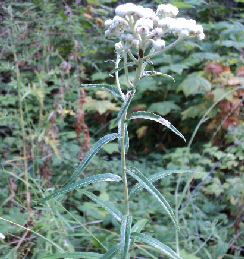
General 20-100 cm tall. [PPNC]
Lifecycle Perennial [PFAF]
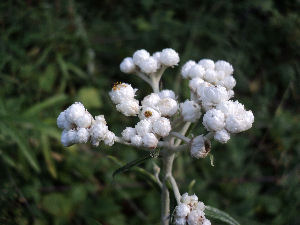
Flowers In August. dioecious (male or female)[PFAF] disk flowers yellowish [IFBC-E-flora], surrounded by pearly white bracts. [WildPNW] Dry. [PPNC]
Fruits Very small, roughened, hairless to sparsely hairy achenes. [PPNC]
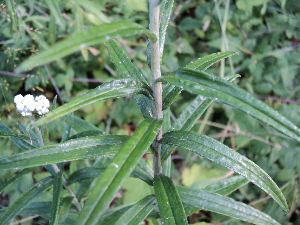
Leaves Leaves linear [PSW] to lanceolate [HNW] and alternately arranged. [PSW] Greenish above [PPNC] with sparse white hairs, thickly covered beneath[WildPNW] with white-woolly hairs. [PPNC] margins often rolled under. [IFBC-E-flora]
Stem Stems erect [WildPNW], usually unbranched [IFBC-E-flora] and usually clustered [HNW]
Root Rhizomes.[PPNC]
Habitat Moist to dry meadows, open forests, logging units, fields and roadsides in the lowland, montane and subalpine zones.[IFBC-E-flora]
Range Common and widespread throughout our region.[PPNC] All but NE BC; N to AK, YT, and NT, E to NF and NS and S to NC, KY, AZ, NM and CA.[IFBC-E-flora] "Interruptedly circumboreal, in North America from NL (Labrador) and NL (Newfoundland) west to AK, south
to NC, TN, OK, TX, NM, CA, and Baja California." [Weakley FSMAS]
Status Native.[E-flora] An American native, introduced to and now established in Britian.[DPL Watts]
Ecological Indicator Shade-intolerant, submontane to subalpine. Water-shedding sites within alpine tundra, boreal. cool temperate, and cool mesothermal climates. Exposed mineral soil on cutover sites, clearings, and waysides. Characteristic of disturbed sites.[IPBC-E-flora]
Related Genera
Gnaphalium Sp & Antennaria Sp.
"If you run across a similar plant, but less fuzzy, with yellowish white blossoms, and with crushed foliage that smells balsamic or piney, it is a closely related Gnaphalium (Field Balsam or Cudweed), with the same uses and greater expectoration effects. If you run across a similar plant that has short flowering stems rising out of dense mats of silvery basal leaves (usually in the mountains), it is another relative, Antennaria (Cat's Foot or Pussy Toes). These three genera are closely related, some of the taxonomic c:liffurences are moot, and to some degree they are interchange- able as remedies." [Moore MPPW]
"Male and female flowers grow on different flower heads. The seed is a minute oblong achene with a tuft of fine bristles found only on the female plant (Peck 1961, Kruckeberg 1982, USDA 1988)." [PPNWNP]Anaphalis margaritacea, or Pearly Everlasting, is a versatile medicinal herb known for its astringent, anti-inflammatory, and sedative properties. It has a long history of use in Indigenous North American medicine, primarily for treating the respiratory system and skin trauma.
"The herbage of western pearly-everlasting has been used as a tobacco substitute to relieve headaches. As a tea, the plant has been used for colds, bronchial coughs, and throat infections. The whole plant can be used as a wash or poultice for external wounds. It has also been used for rheumatism, burns, sores, bruises, and swellings (Strike 1994)." [Vizgirdas WPSN]
"Ida Jones, of the Ditidaht Nation, used to assist her grandfather, who was an Indian doctor, in his practice. She recalled that he always had her rub her hands with leaves and tops of pearly everlasting (Anaphalis margaritacea) to soften her skin when she was touching his patients (cited in Turner, Thomas, et al. 1983)." [APAK Turner]
Anaphalis margaritacea (L.) Benth. & Hook. f. - Foot numbness/sores; blurred vision [Ramzan PESR]
Popular Indications: Asthma, Bronchosis, Bruise, Burn, Catarrh, Cold, Cough, Dermatosis, Diarrhea, Dysentery, Insomnia, Nervousness, Pain, Paralysis, Pulmonosis, Rheumatism, Sore, Tumor.[HMH Duke] influenza medicine. [PPNC]
"Foot numbness/sores; blurred vision" [Ramzan PESR]
"The Herbalists 93 states that the plant is valuable for its astringent qualities. It has been used for fevers, quinsy, pulmonary and bronchial complaints." [HuronSmith Zuni]
Listed as having the following indications - Anaphalis margaritacea
"Indications (Pearly Everlasting) — Asthma (f; CEB; DEM); Boil (f; CRC); Bronchosis (f; CRC; DEM); Bruise (f; CEB; CRC; DEM); Burn (f; CEB; DEM); Catarrh (f; CRC; DEM); Cold (f; CEB; DEM); Constipation (f; DEM); Cough (f; CEB; DEM); Cut (f; CRC); Dermatosis (f; CEB; DEM); Diarrhea (f; CRC; DEM; FAD); Dysentery (f; CRC; DEM; FAD); Dyspnea (f; DEM); Edema (f; CRC); Fever (f; DEM); Gastrosis (f; DEM); Infection (f; DEM); Insomnia (f; CRC; FAD); Nervousness (f; CRC; FAD); Ophthalmia (f; DEM); Pain (f; CEB; CRC; FAD); Paralysis (f; CEB; DEM); Pulmonosis (f; CRC; FAD); Rheumatism (f; DEM; FAD); Sore (f; DEM; FAD); Sore Throat (f; DEM); Sprain (f; CRC); Stroke (f; DEM); Sun Blindness (f; DEM); Swelling (f; DEM); Tuberculosis (f; DEM); Tumor (f; CRC; JLH); Worm (f; CEB)." [HMH Duke]
"(1) Anaphalis margaritacea; (2) PEARLY-EVERLAST- .... (5) analgesic, antidiarrheal, antirheumatic, disinfectant, stimulant, tonic; (6) common cold, cough, eye ailments, gastrointestinal disturbances, orthopedic ailments, respiratory ailments, sore, swelling, throat ailments, tuberculosis; (8) Cherokee, Cheyenne, Chippewa, Delaware, Iroquois, Kwakiutl, Mohegan, Montagnais, Ojibwa, Potawatomi, Quileute; (9) poultice". [CRC Eth]
"CONSTITUENTS Anaphalin and gnaphalin (monoterpenes) and the fla- vones luteolin and quercitin, together with volatile oils, varying from very little in Anaphalis and Antennaria to a fair amount (and therapeutically important) in Gnaphalium. COLLECTING Gather the herb in flower, preferably in late summer when the blossoms are still compacted; dry Method A. STABILITY Pearly Everlasting should be usable for a couple of years, the aromatic Gnaphalium (Cudweed) perhaps for eighteen months. PREPARATION Standard Infusion or a strong simple infused tea of the whole dried herb, as needed; the dried leaves, rubbed into fuzzy wads, used with water as a poultice; the dried leaves, partially rubbed, as a smoking herb; the dried flowers, briefly simmered in a little water, cooled to warm, applied to burns, and covered with a moist cloth." [Moore MPPW]
"As a poultice the leaf is helpful for bruises and contusions, soothing and decreasing redness and swelling. It does not seem too useful for joint pain, or inflammation that is multitissued or deep, although it has a long history of folk use for that purpose. The leaf poultice and espe- cially the flower poultice are stimulating and healing to sunburns and other moderate bums from heat and friction. The aromatic Gnaphaliums are a little better, but Anaphalis margaritacea works quite nicely as well. This is another one of our gentle, almost forgotten, and frequently us- able homely medicines. [Moore MPPW]
"Gnaphalium. Gnaphalium margaritaceum L. (More correctly Anaphalis margaritacea (L.) Benth. and Hook.) Cudweed. Life-everlasting. Pied de Chat, Immortelle, Fr. Katisenpfotchen, Immerschon, G. (Fam. Compositea.)—An indigenous herbaceous perennial, which with G. obtusifolium L. (G. polycephalum Michx.), or sweet-scented life-everlasting, is sometimes used in the form of tea in intestinal and pulmonary catarrhs, and, externally, in the way of fomentation, in bruises, but it probably possesses little medicinal virtue. In Europe different species of Gnaphalium are occasionally employed for similar purposes." [Remington USD20]
"The herbage of western pearly-everlasting has been used as a tobacco substitute to relieve headaches. As a tea, the plant has been used for colds, bronchial coughs, and throat infections. The whole plant can be used as a wash or poultice for external wounds. It has also been used for rheumatism, burns, sores, bruises, and swellings (Strike 1994)." [Vizgirdas WPSN]
"The plants were dried by the fire, mixed with yellow cedar pitch (Chamae- cyparis noo tkatensis) and used to poultice sores and swellings. They were also boiled and drunk for internal disorders (John- son, 1969; King, 1972)." [Turner&Bell2]
Anaphalis margaritacea (L.) Benth., & Hook.f. [Anaphalis cinnamomea (DC.) C. B. Clarke] - Leaves Cuts, wounds Kapur and Nanda, 1992 [Pullaiah EOI]
"The Cheyenne, also of North America, burned the leaves as incense and to purify the gifts they offered to their spirits (Grinnell 1905; Hart 1981). The Forest Potawatomi smoked dried flowers or placed them on hot coals to drive away evil spirits by irri- tating their eyes (Smith 1933)." [UAPDS]
"Anaphalis margaritacea (Linnaeus) Bentham American cudweed, pearly everlasting North America; introduced into Europe Under the name Centunculus (a generic name long used by botanists for the minuscule plant now called Anagallis minima (Linnaeus) E. H. L. Krause), William Turner described a herb ‘thought to be good for chafinge of anye man’s flesh with goynge or rydinge’, for which reason it was known in his native Northumberland, he wrote, as‘Chaf[e]weed’ and in Yorkshire as‘cud- weed’.126 Though some authors127 have argued that he must have been refer- ring to heath cudweed (Gnaphalium sylvaticum Linnaeus), as he separately mentioned the species now known as Filago vulgaris under a different name, others128 have assumed he meant the latter nonetheless.Matters have not been helped by the fact that John Gerard129 chose to illustrate what he called‘Eng- lish cudweede’with a figure of what is unambiguously G. sylvaticum—though it is apparent from the text that he understood by ‘cudweed’ and ‘chaffweed’ various Filago and Gnaphalium species in just a vague, collective sense.130 Fortunately, Matthias de l’Obel in 1576 was a model of clarity by com- parison: his figure is undoubtedly Filago vulgaris, which he says the common people in the west of England pound, steep in oil and boil for use on spots, bruises, cuts and lacerations.131 By the west of England he doubtless meant the neighbourhood of Bristol, where he practised medicine on first arriving as an immigrant, and Gnaphalium sylvaticum is much too scarce in that part of the country to have served as a herbal source. Though the use of the plant appears to have died out in England a century or so after de l’Obel wrote (John Parkinson in 1640 merely paraphrases his words), Filago vulgaris has borne a name in Manx, lus ny croshey, which has been interpreted as implying a herbal application of some (unknown) kind.132 At the same time ‘cudweed’ can be short for the American cudweed or pearly everlasting, Anaphalis margaritacea, a garden plant which is on record as smoked like tobacco for a cough or headache in Suffolk.133 This was probably the ‘cudweed’ reported from Wexford in the 1930s as a whoop- ing-cough cure.134 [MPFT]
The following tables represent the identified chemical compounds of Anaphalis margaritacea categorized by their molecular class. These constituents contribute to the plant's documented astringent and anti-inflammatory properties.
"4947 trans-Dehydromatricaria ester Methyl-trans-2-decene-4,6,8-triynoate [692-94-4] C11H8O2 (172.19). mp 105ºC. Source: BI MA GEN Ricinus communis, DA YE BAI TOU WENG Anaphalis margaritacea. Ref: 6." [Encyclopedia of TCM V2]
"6027 2,3-Dihydroxy-2-methyl-butyolactone C5H8O4 (132.12). White granular crystals (acetone). Pharm: Cytotoxic (stronger). Source: DA YE BAI TOU WENG Anaphalis margaritacea, GUAN GUANG MU Tsoongiodendron odorum. Ref: 2177, 3853." [Encyclopedia of TCM V2]
"7751 Fenchone 1,3,3-Trimethylbicyclo[2.2.1]heptan-2-one [1195-79-5] C10H16O (152.24). mp (+) 5.5ºC, (−) 6ºC, bp (±) 72~73ºC/12mmHg. Pharm: Local stimulant. Source: BEI MEI YA BAI Thuja occidentalis, CE BAI YE Thuja orientalis [Syn. Platycladus orientalis; Biota orientalis], FU SHE SONG Pinus radiata, HUANG HUA HAO Artemisia annua, HUI XIANG Foeniculum vulgare, LIU YE MU LAN Magnolia salicifolia, SHUI SHAN Metasequoia glyptostroboides, XIA KU CAO Prunella vulgaris, XIANG LI Chenopodium botrys, XIANG ZHI LENG SHAN Abies balsamea, XUAN YE XIANG QING Anaphalis contorta, ZHANG MU Cinnamomum camphora. Ref: 6, 658, 660." [Encyclopedia of TCM V2]
TABLE 12.2
Flavonols and Their Methyl Ethers — continued
"Prefers a light well-drained soil and a sunny position[1, 133]. Requires a moist soil[208]. Succeeds in most soils[200], including poor ones[1], and also in light shade[200]. Succeeds in the shade of buildings, but not of trees[233]." [PFAF]
Anaphalis margaritacea Facultative AM 585 AM 260, 261 (wang2006)
Perennial herb [subshrub], fibrous-rooted, from rhizome; ± dioecious.
Stem: generally erect.
Leaf: basal and cauline, alternate, sessile [petioled], linear to lanceolate or oblanceolate, narrowed at base, entire, adaxially green and ± glabrous or ± gray-tomentose, abaxially generally white to gray, tomentose or becoming glabrous, glandular or not.
Inflorescence: heads discoid or disciform, ± unisexual (sometimes a few pistillate flowers peripheral in generally staminate heads or 1–9 staminate flowers central in generally pistillate heads), in tight groups in ± flat-topped or panicle-like cluster; involucre ± spheric; receptacle flat, epaleate, glabrous; phyllaries ± graduated in 8–12 series, bright white, opaque, often proximally woolly.
Pistillate flower: many; corolla ± yellow, narrowly tubular, minutely lobed; anthers 0.
Staminate flower: corolla ± yellow; anther tip ovate; style tips truncate.
Fruit: oblong to obconic, 2-veined, papillate with club-shaped hairs; pappus bristles generally deciduous, free or basally fused, tips club-shaped in staminate flowers.
± 100 species: mostly Eurasia, 1 North America. (Ancient name or perhaps from generic name Gnaphalium) [Nesom 2006 FNANM 19:426–427] [Jepson] "The genus Anaphalis (Asteraceae) consists of about
80 species distributed throughout the world and more
than 50 species are distributed in china [1] and 31 species reported in India [2]." [Khemani CP]
Non-local Species
"The genus Anaphalis (Asteraceae) consists of about 80 species distributed throughout the world and more than 50 species are distributed in china [1] and 31 species reported in India [2]. Anaphalis busua (Bugla) is an erect tall herb. Stem usually branched from base, somewhat winged. Leaves sessile, linear lanceolate or oblanceolate most abundantly present in open places of oak and pine forests of submountain and mountain Himalayas. Leaf juice applied on bruises, wounds and cuts [2]. Anaphalisqualenol, anapharenosoic acid and araneosol isolated from the plant previously [3–4]. Isoquercitrin and astragalin, anaphalol, 5-hydroxy 7-O-3’-methyl bute 2’-enylpthalide and 5, 7-dihy- droxyphalide, 5-methoxy-7-hydroxy pthalide and β-sitosterol isolated form other species of the plant [5–6]. The present paper deals with the isolation and structure elucidation of a flavonoidal glycoside 1 from alcoholic extract of the leaves of A. busua." "The compound 1 identified as tiliroside". (Khemani CP)
Flavonoids of the Sunflower Family
"Anaphalis is a moderately large genus with 15-30 (possibly up to 60; Dillon and Sagastegui, 1991b), 60-100 (Merxmuller et aI., 1977) or about 110 (Anderberg, 1994) species. Most are Asian but a few occur in North America." [Bohm FSF]
"Ali et ai. (1979) identified 5,7-dihydroxy-3,6,8-trimethoxyflavone and 5,7-dihydroxy-3,6,8,4'-tetramethoxyflavone from extracts of A. araneosa." [Bohm FSF]
"B-Ring deoxyflavonoids were also reported from A. velutina by Ikramov et at. (1986) who isolated 3,5-dihydroxy-6,7,8-trimethoxyflavone and 5-hydroxy- 3,6,7,8-tetramethoxyflavone. (We could find no record of this epithet.)" [Bohm FSF]
"Kaempferol and quercetin 3-0-glucosides have been reported from A. contorta (Lin, 1993)." [Bohm FSF]
TABLE 13.2
New Flavonol Glycosides — continued
Table 4. Sesquiterpene lactones with antineoplastic and cytotoxic activity isolated from 1976-1986
Terpenes
Aphid Host Plant
This graph represents the unique prevalence of "Anaphalis" within the Eflora local research library. Penetration indicates the percentage of total documents containing at least one of the search terms.