Eriophyllum lanatum - Woolly eriophyllum
Family: Asteraceae (Aster family) [E-flora]
Description
- General:
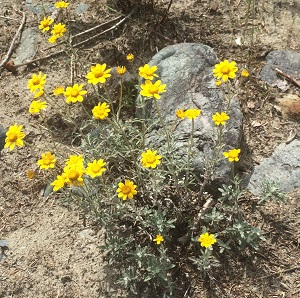
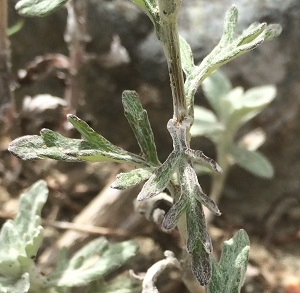
"Perennial herb from a fibrous root; stems woolly, few- to much- branched from the base, 10-60 cm tall." [IFBC-E-flora]
- Leaves:
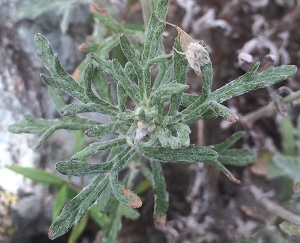
" Basal leaves few, soon deciduous; stem leaves alternate to opposite, entire to narrowly lobed, 1-8 cm long." [IFBC-E-flora]
- Flowers:
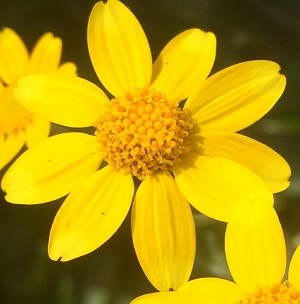
"Heads with ray and disk flowers, solitary on long stems; ray flowers 8-13, yellow, 1-2 cm long; involucres 9-12 mm tall; involucral bracts firm, erect, embracing the ray achenes." [IFBC-E-flora]
- Fruits: "Achenes slender, 4-angled, glabrous to hairy; pappus of 6-12 translucent scales, or a toothed crown." [IFBC-E-flora]
- Status: Native [E-flora]
- Habitat / Range: "Dry meadows and rocky slopes from the lowland to the montane zones; common on Vancouver Island and the adjacent mainland, rare in SC and SE BC; S to MT, WY, UT and CA." [IFBC-E-flora]
Ecological Indicator Information: "A very shade-intolerant, submontane to montane, Western North American forb distributed equally in the Pacific and Cordilleran regions. Occurs in cool temperate and cool mesothermal climates on excessively dry to very dry, nitrogen-medium soils. Its occurrence increases with increasing precipitation and elevation. Grows in non-forested, grassy communities very shallow, on water-shedding sites; often inhabits disturbed sites. Characteristic of moisture-deficient sites." [E-flora]
Other Uses
- love medicine [Heaton,2004]
Medicinal Uses
- Dermatological aid [Heaton,2004]
Phytochemicals
- Eriolangin [Bajaj MAPS 2][Connolly DT]
- Eriolanin [Bajaj MAPS 2][Connolly DT]
- 2a-Acetoxy-8-epiivangustin
- "Consit. of Eriophyllum lanatum. Gum."[Connolly DT]
- (1B,2a,8B)-form
1,2-Dihydroxyalantolactone - Mp 170o[Connolly DT]
- 1,6,14-Trihydroxyeriolanolide - Gum [Connolly DT]
- Eriolangin [Connolly DT]
- Eriolanin [Connolly DT]
- 1,6,14-Trihydroxy-l, 1O-seco-5(1O),11(13)-eudesmadien-12,8-
olide; 61X-form, 14-(Methylpropanoyl) [Connolly DT]
- 1,6,14-Trihydroxy-I, 1O-seco-5(1O),11(13)-eudesmadien-12,8-
olide; 61X-form, 14-(Methylpropanoyl), I-Ac [Connolly DT]
- 1,6,14-Trihydroxy-l, 1O-seco-5(1O),11(13)-eudesmadien-12,8-
olide; 61X-form, 14-(Methylpropanoyl), 6-Ac [Connolly DT]
- 1,6,14-Trihydroxy-I, 10-seco-5(10),11(13)-eudesmadien-12,8-
olide; 61X-form, 14-(Methylpropanoyl), 1,6-di-Ac [Connolly DT]
- 1,6,14-Trihydroxy-l,10-seco-5(10),11(13)-eudesmadien-12,8-
olide; 61X-form, 14-(2-Methylpropenoyl) [Connolly DT]
- 1,6,14-Trihydroxy-l,10-seco-5(1O),II(13)-eudesmadien-12,8-
olide; 61X-form, 14-(2-Methylpropenoyl), I-Ac [Connolly DT]
- 1,6,14-Trihydroxy-I,1O-seco-5(1O),11(13)-eudesmadien-12,8-
olide; 61X-form, 14-(2-Methylpropenoyl), 6-Ac [Connolly DT]
- 1,6,14-Trihydroxy-l, 1O-seco-5(1O),11(13)-eudesmadien-12,8-
olide; 61X-form, 14-(2-Methylpropenoyl), 1,6-di-Ac [Connolly DT]
"Another possibility is for small-scale production of the major
acetylenes produced by the roots; root cultures of Eriophyllum lanatum have been
used in this way." [Bajaj MAPS 3]
Eriophyllum Sp. - Woolly Sunflower
"Annual to shrub, ± woolly. Leaf: generally alternate, proximal sometimes opposite, entire to nearly compound. Inflorescence: heads 1–many, generally radiate; often in ± flat-topped clusters; involucre obconic to hemispheric; phyllaries 4–13(15) in 1 series, free or ± fused; receptacle flat to columnar, smooth or pitted (occasionally 1–6 palea-like scales at tip). Ray flower: 0 or generally ± 1 per phyllary; ray entire to lobed, generally yellow (white). Disk flower: (3)10–300; corolla yellow; anther tip ovate, deltate or awl-shaped; style tips ± ovate, papillate. Fruit: 4(5)-angled or outer fruits flattened, inner fruits generally club-shaped; pappus of 0–15 ± jagged or fringed scales.
13 species: western North America. (Greek: woolly leaf) [Johnson & Mooring 2006 FNANM 21:353–362] Eriophyllum nevinii moved to Constancea.
Unabridged references: [Mooring 2002 Amer J Bot 89:1973–1983]" [Jepson]
Local Species;
- Eriophyllum lanatum var leucophyllum - Woolly eriophyllum [TSFTK][PCBC][E-flora]
Food Use
"Eriophyllum seeds were parched and ground into a flour by
Cahuilla and Luiseno Indians in California. The seeds were also incorporated
into pinole." [Vizgirdas WPSN]
Phytochemicals
"Seven species have been studied for flavonoids
by Rarborne and Smith (1978): E. ambiguum, E. confertiflorum, E. lanatum
var. obovatum, E. multicaule, E. pringlei, E. staechadifolium, and E.
wallacei. Quercetin 5-0-glucoside, quercetagetin 7-0-glucoside, and
patuletin 7-0-glucoside were identified, although not all taxa exhibited all
three compounds." [Bohm FSF]
Eriophyllum confertum
- Eriophyllum confertum - Patuletin - Aerial parts [Andersen FCBA]
- Eriophyllum confertum - Axillarin - Aerial parts [Andersen FCBA]
- Eriophyllum confertum - Spinacetin - Aerial parts [Andersen FCBA]
- Eriophyllum confertum - Centaureidin - Aerial parts [Andersen FCBA]
Eriophyllum confertiflorum
Eriophyllum staechadifolium
- Eriophyllum staechadifolium - Isorhamnetin - Aerial parts [Andersen FCBA]
- Eriophyllum staechadifolium - Axillarin - Aerial parts [Andersen FCBA]
- Eriophyllum staechadifolium - Jaceidin - Aerial parts [Andersen FCBA]
- Ligustrin - Mp 135-137o[Connolly DT]
- "Presilphiperfolan-1-ol ..., which has been isolated from Eriophyllum
staechadifolium ...and known as a rearrangement product from isocaryophyllene
..., was isolated from the essential oil of Conocephalum conicum...." [Asakawa CCB]
- "(-)-8B[beta]-Presilphiperfolanol from Eriophyllum staechadifolium" [Breitmaier terpenes][Connolly DT]
Eriofertopin - "Constit. of Eriophyllum confertifiorum. Shows
antileukaemic props" [Connolly DT]
Eriolin - Constit. of Eriophyllum confertiflorum [Connolly DT]
Cultivation & Propagation
Aphid Host Plant
- E. staechadifolium - Pleotrichophorus longirostris. "On Eriophyllum staechadifolium in California, USA" [Blackman AWHPS]
Journals of Interest
- Norton RA, Finlayson AJ, Towers GHN (l985a) Two dithiacyc10hexadiene polyacetylenes from
Chaenactis douglasii and Eriophyllum lanatum. Phytochemistry 24:356-357
References
- [E-flora] - http://linnet.geog.ubc.ca/Atlas/Atlas.aspx?sciname=Eriophyllum%20lanatum, In Klinkenberg, Brian. (Editor) 2017. E-Flora BC: Electronic Atlas of the Plants of British Columbia [eflora.bc.ca]. Lab for Advanced Spatial Analysis, Department of Geography, University of British Columbia, Vancouver. [Accessed: 09/06/2018 6:45:06 PM ]
- [Heaton,2004] - An Ethnobotanical and Medical Research Literature Update on the Plant Species Collected in the
Lewis and Clark Expedition of 1803-1806, Darrall Heaton and Ara DerMarderosian, Bartonia, No. 62, Lewis and Clark Bicentennial: 1803-1806 — 2003-2006 (2004), pp. 63-93, Philadelphia Botanical Club
- [Jepson] 2013. Eriophyllum, in Jepson Flora Project (eds.) Jepson eFlora, http://ucjeps.berkeley.edu/cgi-bin/get_IJM.pl?tid=430, accessed on Jan 20 2015